

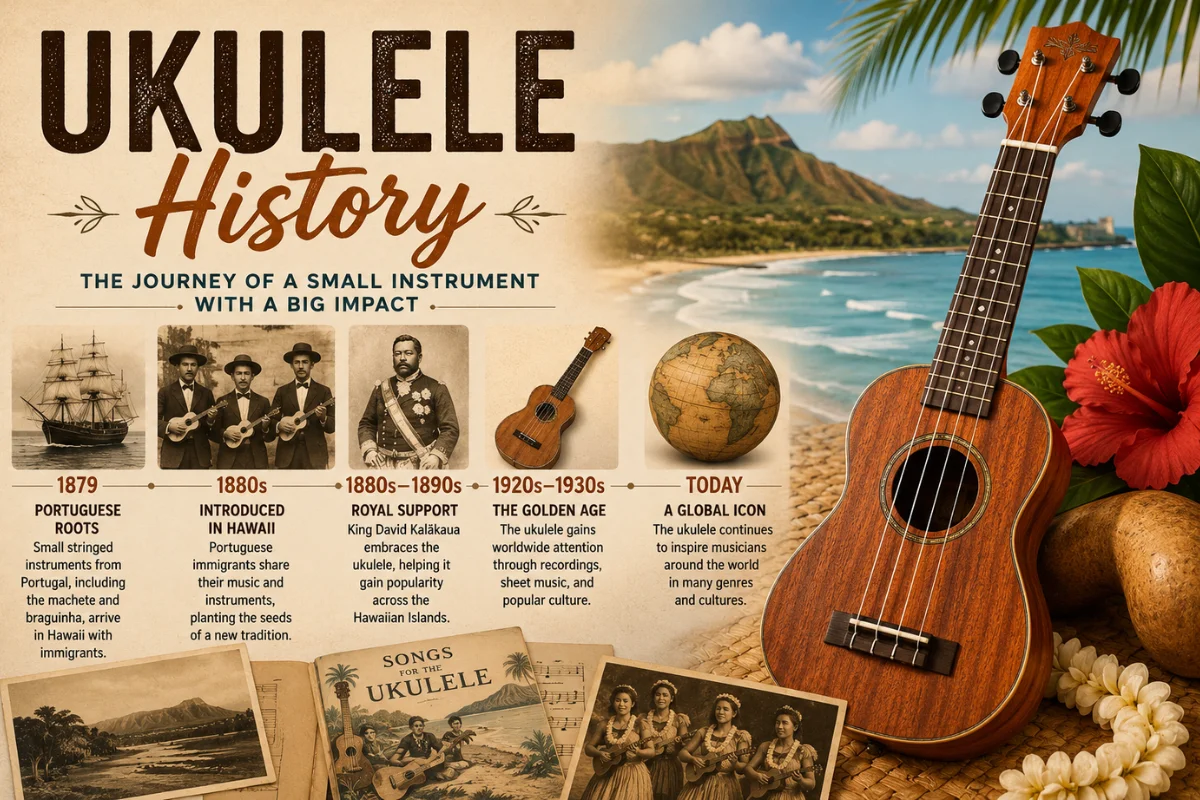
The ukulele is one of the most recognizable string instruments in the world. Small, lightweight, and known for its bright and cheerful sound, it has captured the hearts of musicians across generations. While many people associate the ukulele with Hawaiian culture and tropical music, its history is much richer and more complex than most realize.
From its European roots to its transformation in Hawaii and eventual rise as a global musical phenomenon, the ukulele has experienced a remarkable journey. Today, it is played by beginners, professional musicians, educators, and hobbyists in nearly every corner of the world.
This article explores the complete history of the ukulele, tracing its origins, evolution, cultural significance, and enduring popularity.
What Is a Ukulele?
The ukulele is a small stringed instrument that typically features four strings and resembles a miniature guitar.
It is known for its:
- Compact size
- Bright tone
- Easy playability
- Portable design
- Versatility across musical genres
Although often associated with Hawaiian music, the instrument’s origins can be traced to Europe before it became a cultural symbol of Hawaii.
The European Roots of the Ukulele
The story of the ukulele begins in the 19th century, thousands of miles away from Hawaii.
Several small stringed instruments from Portugal played a key role in its development. Among these were the:
- Machete
- Braguinha
- Rajão
These instruments were commonly played on the Portuguese island of Madeira.
Portuguese immigrants carried these instruments with them when they traveled abroad in search of new opportunities.
This migration would ultimately change the course of musical history.
Portuguese Immigrants Arrive in Hawaii
In the late nineteenth century, many Portuguese workers emigrated from Madeira to Hawaii.
They arrived primarily to work on sugar plantations during a period of economic expansion.
Along with their belongings, they brought their musical traditions and instruments.
The local Hawaiian population quickly became interested in the unique sound produced by the small stringed instruments.
Musicians began adapting the designs and playing styles to suit local tastes and musical traditions.
This cultural exchange laid the foundation for the birth of the ukulele.
How the Ukulele Got Its Name
The origin of the word “ukulele” has fascinated historians for decades.
In the Hawaiian language, the term is commonly translated as “jumping flea.”
Several theories attempt to explain this unusual name.
One popular explanation suggests that the rapid finger movements of players resembled the motion of a jumping flea.
Another theory connects the name to a nickname given to an early Portuguese musician known for his energetic playing style.
Regardless of its exact origin, the name became firmly associated with the instrument and remains recognized worldwide today.
The Birth of the Hawaiian Ukulele
As Portuguese instruments gained popularity in Hawaii, local craftsmen began modifying them.
These changes included:
- Altered body shapes
- Different tuning methods
- Unique construction techniques
Over time, the instrument evolved into a distinctly Hawaiian creation.
Three immigrant craftsmen are often credited with helping establish the early ukulele:
- Manuel Nunes
- Augusto Dias
- José do Espírito Santo
Their craftsmanship played a major role in refining the instrument and introducing it to Hawaiian society.
Royal Support and Growing Popularity
A major turning point in ukulele history came when Hawaiian royalty embraced the instrument.
King David Kalākaua, often called the “Merrie Monarch,” supported Hawaiian arts, music, and cultural traditions.
The ukulele became a regular feature at royal gatherings and celebrations.
Royal endorsement elevated the instrument’s status and helped spread its popularity throughout the Hawaiian Islands.
As more people learned to play it, the ukulele became deeply woven into Hawaiian musical culture.
Early Ukulele Construction
The earliest ukuleles were handcrafted using local Hawaiian woods.
Koa wood became particularly important because of its:
- Durability
- Attractive grain patterns
- Rich tonal qualities
Traditional builders carefully selected materials to achieve the desired sound and appearance.
These handcrafted instruments were often considered works of art as well as musical tools.
Many vintage ukuleles from this era remain highly valued by collectors today.
Types of Ukuleles
As the instrument evolved, different sizes emerged to accommodate varying musical needs.
Soprano Ukulele
The soprano is the smallest and most traditional ukulele.
It produces the classic bright tone commonly associated with Hawaiian music.
Concert Ukulele
The concert ukulele offers a slightly larger body and more playing space.
Many beginners find it comfortable to learn on.
Tenor Ukulele
The tenor provides a fuller sound and greater volume.
It is popular among professional performers.
Baritone Ukulele
The baritone is the largest standard ukulele.
Its deeper tone resembles that of a guitar more closely than smaller ukuleles.
Ukulele Sizes at a Glance
| Ukulele Type | Average Size | Sound Characteristics | Best For |
| Soprano | Smallest | Bright and traditional | Beginners and traditional players |
| Concert | Medium-small | Balanced and clear | General use |
| Tenor | Medium-large | Rich and louder | Performers |
| Baritone | Largest | Deep and warm | Advanced players |
The Ukulele Reaches the United States
The ukulele’s popularity expanded significantly during the early twentieth century.
One of the most important moments occurred when Hawaiian musicians performed at international exhibitions and cultural events.
Audiences were captivated by the instrument’s unique sound and portability.
As interest in Hawaiian culture grew across the United States, demand for ukuleles increased dramatically.
Music stores began stocking instruments, and instructional materials became widely available.
The ukulele was no longer limited to Hawaii.
The First Golden Age of the Ukulele
The 1920s and 1930s are often considered the first golden age of the ukulele.
During this period:
- Music publishers released ukulele songbooks.
- Manufacturers increased production.
- Amateur musicians embraced the instrument.
- Popular songs featured ukulele accompaniment.
Its affordability made it accessible to people from various economic backgrounds.
Families often gathered around the instrument for entertainment before television became widespread.
Decline and Changing Musical Trends
Like many musical instruments, the ukulele experienced periods of declining popularity.
After World War II, changing musical tastes shifted public attention toward:
- Electric guitars
- Rock music
- Larger bands
- New recording technologies
Although the ukulele remained important in Hawaiian culture, its mainstream popularity diminished for several decades.
However, the instrument never disappeared completely.
Dedicated musicians continued preserving its traditions.
The Ukulele Revival
The late twentieth century brought renewed interest in the ukulele.
Several influential performers helped introduce the instrument to new audiences.
One of the most significant figures was the legendary Hawaiian musician and singer Israel Kamakawiwoʻole.
His memorable performances showcased the emotional depth and versatility of the ukulele.
As recordings spread globally, interest in learning the instrument increased once again.
The Internet and Global Growth
The rise of the internet dramatically accelerated the ukulele’s popularity.
Online resources made learning easier than ever.
Aspiring players could access:
- Video tutorials
- Chord charts
- Virtual lessons
- Performance videos
- Online communities
Social media platforms further expanded the instrument’s reach.
Musicians from different countries began sharing performances and teaching techniques with global audiences.
The ukulele became a truly international instrument.
Why the Ukulele Remains Popular Today
Several factors explain the instrument’s enduring appeal.
Easy to Learn
Compared to many stringed instruments, the ukulele is beginner-friendly.
Simple chord shapes allow new players to start making music quickly.
Affordable
Entry-level ukuleles are often less expensive than guitars and many other instruments.
This accessibility attracts students and hobbyists.
Portable
Its compact size makes it easy to transport and store.
Travelers frequently choose the ukulele because it can fit into small spaces.
Versatile
Modern musicians use the ukulele across numerous genres, including:
- Pop
- Folk
- Jazz
- Rock
- Country
- Classical music
Its adaptability continues to attract creative performers.
Cultural Importance of the Ukulele
The ukulele remains a powerful symbol of Hawaiian culture.
It represents:
- Community
- Storytelling
- Musical heritage
- Cultural identity
Many traditional Hawaiian performances still feature the instrument prominently.
At the same time, musicians around the world have adopted it and incorporated it into their own cultural traditions.
This balance between tradition and innovation contributes to the ukulele’s lasting significance.
The Future of the Ukulele
The future of the ukulele appears bright.
Music educators increasingly use it in classrooms because of its simplicity and affordability.
Manufacturers continue developing new designs and materials.
Online learning platforms make instruction accessible to more people than ever before.
As younger generations discover the instrument, the global ukulele community continues to grow.
Its combination of history, portability, affordability, and joyful sound ensures that it will remain relevant for years to come.
Conclusion
The history of the ukulele is a remarkable story of cultural exchange, innovation, and musical evolution. Originating from Portuguese stringed instruments, it found a new identity in Hawaii and eventually became a beloved instrument around the world.
From royal Hawaiian courts to modern social media platforms, the ukulele has traveled an extraordinary path. Its cheerful sound, ease of learning, and deep cultural roots continue to inspire musicians of all ages.
More than just a small stringed instrument, the ukulele represents the power of music to connect cultures, cross borders, and bring people together through a shared love of creativity and expression.
