

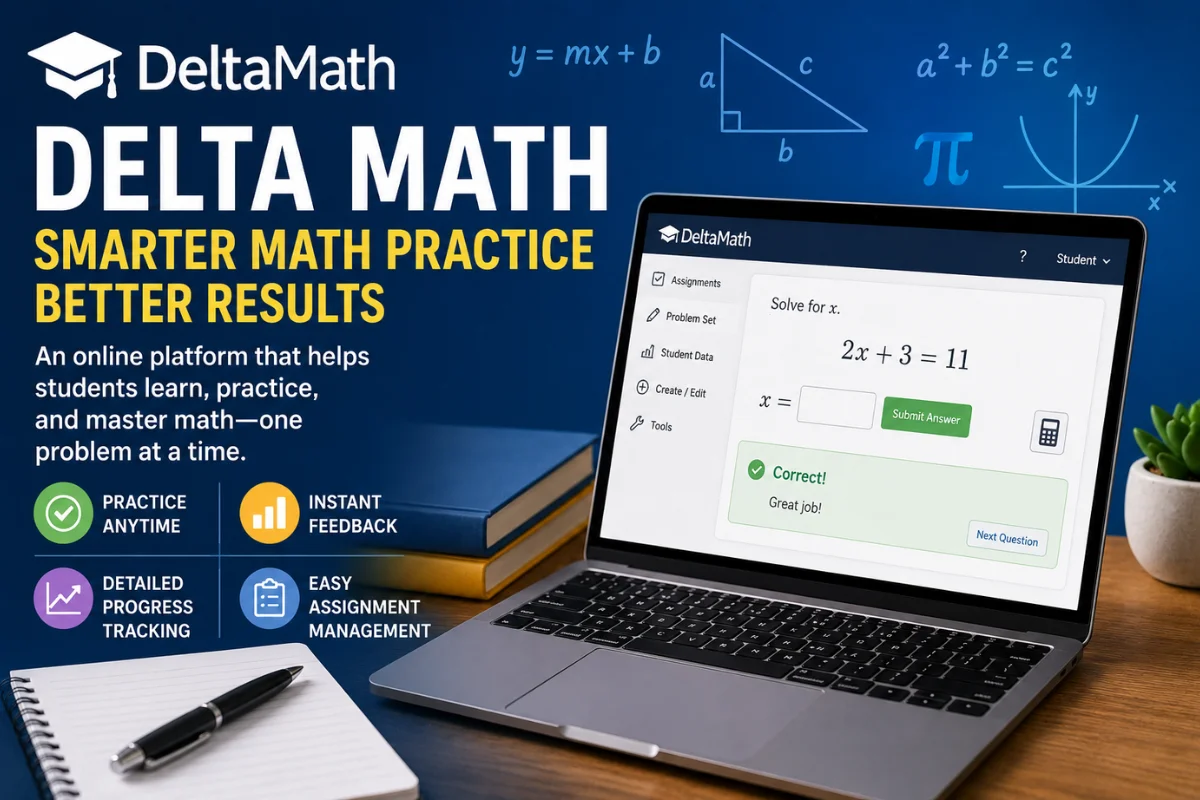
Technology has transformed the way students learn mathematics. Traditional worksheets and textbook exercises are increasingly being supplemented by digital learning platforms that offer interactive practice, instant feedback, and personalized learning experiences.
Among these educational tools, this platform has become one of the most widely used solutions in schools.Designed to help students strengthen their mathematical skills while giving teachers powerful classroom management tools, Delta Math has gained popularity across middle schools, high schools, and even college-level courses.
Whether you are a student trying to improve your grades, a teacher looking for efficient assignment management, or a parent interested in supporting your child’s learning, understanding how Delta Math works can help you maximize its benefits.
This guide explores the platform’s features, advantages, challenges, and impact on modern mathematics education.
What Is Delta Math?
It is an online mathematics learning platform that offers practice exercises, assignments, assessments, and tools to monitor learning progress.
The platform is designed primarily for mathematics instruction and supports a wide range of topics, from basic arithmetic to advanced algebra, geometry, trigonometry, statistics, and calculus.
Teachers can assign customized problem sets, while students complete exercises online and receive immediate feedback on their performance.
The goal is simple: help students practice more effectively while making it easier for teachers to monitor learning progress.
Why Delta Math Has Become So Popular
Educational technology continues to evolve, but Delta Math stands out because it focuses on one specific subject—mathematics.
Instead of trying to cover every academic discipline, the platform specializes in math practice and skill development.
Several factors contribute to its growing popularity:
- Interactive learning experience
- Instant grading
- Detailed progress tracking
- Wide variety of problem types
- Flexible assignment creation
- Accessibility from multiple devices
These features make the platform useful for both classroom instruction and independent learning.
How Delta Math Works
It works through assignments created by teachers.
Students typically join a class using a code provided by their instructor.
Once enrolled, they can access assigned exercises and begin solving problems online.
Each question requires students to demonstrate mathematical understanding rather than simply memorizing answers.
After submitting a response, students often receive immediate feedback that helps them identify mistakes and improve their problem-solving skills.
This instant response system encourages active learning and continuous improvement.
Key Features of Delta Math
The platform includes numerous features designed to improve the learning experience.
Assignment Creation
Teachers can create customized assignments based on specific curriculum goals.
Assignments can target:
- Algebra
- Geometry
- Statistics
- Trigonometry
- Calculus
- Pre-Algebra
This flexibility allows educators to align practice activities with classroom instruction.
Automatic Grading
One of the most valuable features is automated grading.
Teachers no longer need to manually grade large numbers of repetitive math exercises.
The system evaluates answers instantly and records results automatically.
This saves significant time while providing students with immediate performance feedback.
Extensive Question Library
One of its key strengths is its extensive collection of practice questions.
Students encounter different versions of similar problems rather than repeatedly seeing identical questions.
This approach helps reinforce concepts while reducing the likelihood of memorization.
The extensive problem bank also allows teachers to generate assignments that suit different skill levels.
Student Progress Tracking
Monitoring student progress is essential for effective teaching.
Delta Math provides detailed analytics that help teachers identify:
- Strong performers
- Students needing extra support
- Frequently missed questions
- Class-wide learning trends
These insights enable educators to make informed instructional decisions.
Instead of guessing where students struggle, teachers can rely on data-driven information.
Benefits for Students
Students often benefit from it because it provides a more interactive learning experience compared to traditional worksheets.
Immediate Feedback
One of the platform’s greatest strengths is instant feedback.
Rather than waiting days for graded work, students learn immediately whether their answer is correct.
This quick response helps reinforce understanding and correct misconceptions before they become habits.
Flexible Learning
Students can often access assignments from various devices, making it easier to complete work at home, school, or while traveling.
This flexibility supports modern learning environments where education increasingly extends beyond the classroom.
Benefits for Teachers
It is created to serve the needs of both students and educators.
Teachers frequently face challenges such as:
- Limited grading time
- Large class sizes
- Diverse learning needs
- Curriculum planning
The platform helps address these issues through automation and data analysis.
Time Savings
Automated grading significantly reduces administrative work.
Teachers can spend more time:
- Teaching concepts
- Supporting struggling students
- Creating lesson plans
- Providing individualized guidance
This efficiency improves classroom productivity.
Benefits for Parents
Parents often want visibility into their child’s academic progress.
It can encourage parental involvement by promoting regular practice and responsibility.
When students regularly complete assignments, parents gain greater confidence in their learning progress.
The platform also helps students develop independent study habits that can benefit them throughout their education.
Delta Math Features at a Glance
| Feature | Purpose | Benefit |
| Assignment Builder | Create customized tasks | Flexible instruction |
| Automatic Grading | Evaluate answers instantly | Saves teacher time |
| Progress Tracking | Monitor performance | Data-driven teaching |
| Large Question Bank | Diverse practice opportunities | Better concept mastery |
| Immediate Feedback | Correct mistakes quickly | Faster learning |
| Online Access | Learn from anywhere | Greater convenience |
Common Subjects Covered on Delta Math
The platform supports a wide variety of mathematics courses.
Pre-Algebra
Students learn foundational concepts such as:
- Fractions
- Decimals
- Ratios
- Basic equations
Algebra
Algebra assignments often focus on:
- Linear equations
- Functions
- Polynomials
- Systems of equations
Geometry
Geometry topics may include:
- Angles
- Triangles
- Circles
- Transformations
Trigonometry
Students explore:
- Sine
- Cosine
- Tangent
- Graphing functions
Calculus
Advanced learners can practice:
- Limits
- Derivatives
- Integrals
- Applications of calculus
This wide curriculum support makes it useful across different grade levels.
How Delta Math Encourages Independent Learning
Modern education increasingly emphasizes student responsibility.
Delta Math supports independent learning by allowing students to:
- Practice at their own pace
- Review mistakes
- Retry questions
- Build confidence gradually
Students who engage consistently often develop stronger problem-solving abilities over time.
The platform encourages persistence by making practice more interactive and rewarding.
Challenges Students May Face
While Delta Math offers many benefits, some students encounter challenges.
Complex Problems
Advanced courses can include difficult questions that require significant effort.
Students may need additional support from teachers or classmates when learning challenging concepts.
Time Management
Because assignments are often completed online, students must manage deadlines responsibly.
Poor time management can lead to incomplete work and unnecessary stress.
Developing effective study habits remains important.
Tips for Success on Delta Math
Students can maximize their performance by following several strategies.
Practice Consistently
Regular practice strengthens mathematical understanding more effectively than cramming.
Read Questions Carefully
Many mistakes occur because students rush through instructions.
Taking time to understand the question often improves accuracy.
Review Errors
Incorrect answers provide valuable learning opportunities.
Analyzing mistakes helps prevent repeating them in the future.
Ask for Help
When concepts become difficult, seeking assistance from teachers, tutors, or classmates can accelerate learning.
The Role of Delta Math in Modern Education
Digital learning platforms have become an important part of contemporary education.
It shows how technology can enhance traditional teaching instead of replacing it.
Teachers remain central to the learning process.
The platform simply provides tools that enhance efficiency, engagement, and assessment.
As educational technology continues to advance, platforms like this are expected to become increasingly important in supporting mathematics education.
Future Developments in Online Math Learning
The future of educational technology will likely emphasize:
- Greater personalization
- Enhanced analytics
- Adaptive learning systems
- Improved accessibility
- Stronger student engagement
Platforms focused on mathematics education will continue adapting to meet the needs of students and teachers.
The demand for flexible, technology-supported learning environments is expected to remain strong.
Conclusion
Delta Math has become a valuable resource for mathematics education by combining interactive practice, automated grading, detailed analytics, and flexible learning opportunities.
Students benefit from immediate feedback and extensive practice options, while teachers save time through automation and gain insights through performance tracking.
Parents also appreciate the platform’s ability to encourage accountability and independent learning.
As education continues embracing technology, Delta Math remains an important tool for helping students build confidence, strengthen mathematical skills, and achieve academic success.
For anyone involved in mathematics education, learning how to use it effectively can greatly improve student learning outcomes and classroom efficiency.
