

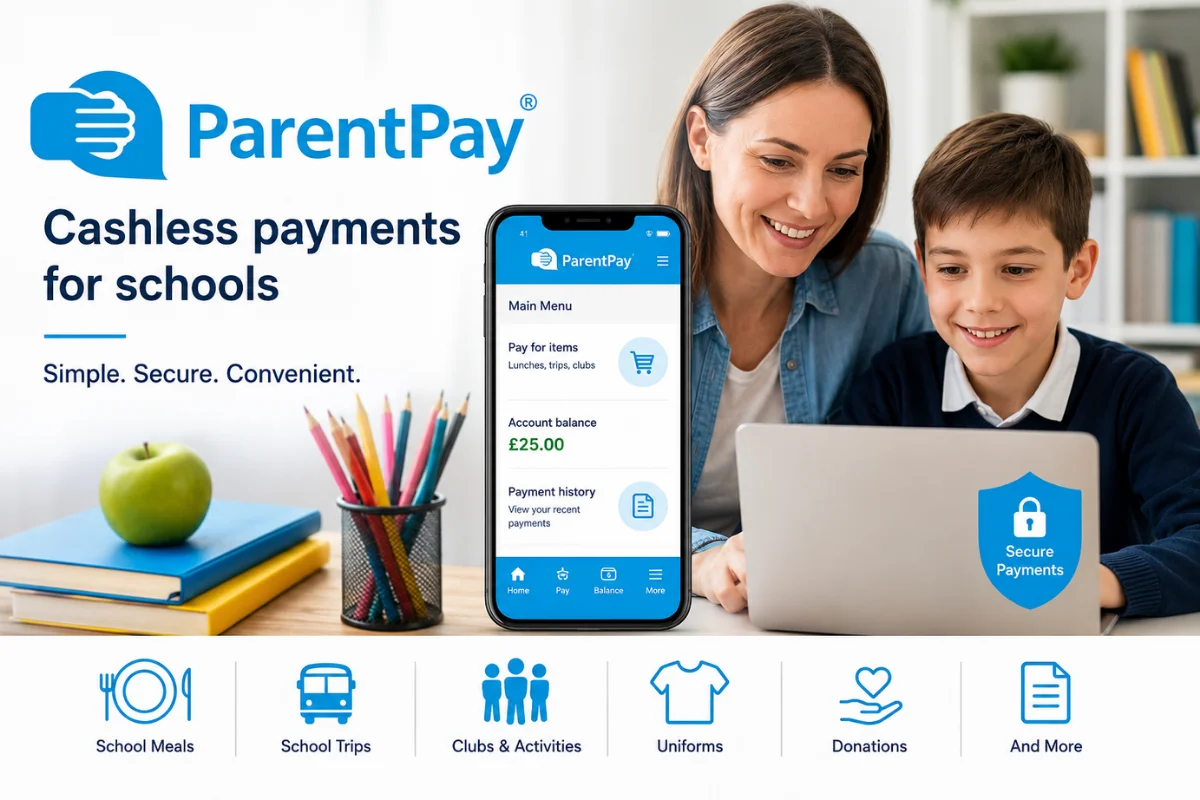
Managing school payments used to involve cash, paper forms, cheques, and plenty of reminders. Today, many schools across the UK use digital payment systems to make this process quicker and easier for both parents and school staff.
ParentPay is one of the best-known platforms in this area. It allows parents and carers to make payments for school-related expenses online while giving schools tools to manage transactions, balances, and payment information more efficiently.
From school meals and trips to clubs and uniforms, ParentPay brings many everyday school payments into one place.
What Is ParentPay?
ParentPay is an online cashless payment system designed for schools, parents, pupils, and educational organisations.
Instead of sending children to school with cash, parents can use the platform to pay for different school-related items electronically. Schools can create payment requests, monitor transactions, and keep financial records in one system.
The service is designed to support more than just occasional payments. Schools can use it for meals, trips, clubs, uniforms, equipment, fundraising, lettings, and other activities.
This makes ParentPay particularly useful for schools that want to reduce the amount of cash they handle every day.
How Does ParentPay Work?
The process is relatively straightforward.
A school first creates a ParentPay account for a parent or carer and provides the information needed to activate it. Once the account has been activated, the parent can log in and view payment items associated with their child.
Depending on what the school offers, parents may see options for school meals, trips, clubs, uniforms, or other charges.
After selecting an item, the parent can follow the payment instructions and complete the transaction through the available payment method.
The system also provides a record of payments, making it easier for parents to keep track of what they have paid.
What Can Parents Pay For Through ParentPay?
One of the biggest advantages of ParentPay is that schools can use it for many different types of payments.
Common examples include:
- School meals
- Educational trips
- After-school clubs
- School uniforms
- Activities and events
- Donations
- Equipment
- Fundraising
- Wraparound care
- Other school services
The exact options depend on the individual school because schools decide which payment items they make available.
ParentPay also supports cashless school meal management, allowing schools to connect meal ordering and payment processes with wider school systems.
ParentPay for School Meals
School meals are one of the most common reasons parents use online school payment services.
With ParentPay’s cashless approach, parents can pay for meals without sending cash with their children. Schools can also use connected meal-management tools to handle ordering, attendance, menus, and payment information.
ParentPay’s Meal Manager is designed to help schools move away from paper-based meal administration. It includes reporting and analytics tools and can integrate with school management information systems.
For schools, this can make meal administration more organised. For parents, it can make ordering and paying for meals more convenient.
Paying for School Trips and Activities
School trips often require parents to make payments by a particular deadline. Managing these payments manually can create extra administrative work for school offices.
ParentPay allows schools to create specific payment items for trips and activities. Parents can then access those items through their accounts and make payments online.
This also gives parents a clearer record of what they have paid.
For schools, having digital payment information in one system can make it easier to monitor outstanding balances and manage large numbers of transactions.
Can ParentPay Be Used for Uniforms and Clubs?
Yes. Schools can use ParentPay for many items beyond meals and trips.
For example, a school may create payment options for uniforms, breakfast clubs, after-school activities, special events, or other services.
This flexibility means the platform can function as a central payment point rather than being limited to one particular type of school expense.
ParentPay and PayPoint
Although ParentPay focuses heavily on digital payments, it can also support families who need to pay in cash through PayPoint.
Parents can use a generated barcode or other school-provided payment method at participating PayPoint locations. The payment can then be transferred into the school’s ParentPay system.
This is useful because not every family will have the same access to online payment methods.
Providing an alternative payment route can help schools make their payment system more accessible while still reducing the amount of cash that school staff need to handle directly.
Main ParentPay Features at a Glance
| Feature | What It Helps With |
| Online payments | Paying for meals, trips, clubs and other school items |
| Payment history | Keeping track of completed transactions |
| Cashless management | Reducing the need for children to carry cash |
| PayPoint | Providing a cash payment option through participating retailers |
| Meal management | Supporting school meal ordering and administration |
| Reporting | Helping schools monitor payments and income |
| MIS integration | Connecting payment information with school management systems |
| Parent communication | Supporting messages and payment-related alerts |
Benefits of ParentPay for Parents
The main advantage for parents is convenience.
Instead of finding cash or filling out paper forms, parents can manage many school payments digitally.
A payment history can also make household budgeting easier. Parents can see what they have paid and identify outstanding payment items without relying on paper receipts.
For families with more than one child, having children connected to the same parent account can also simplify the process.
Another advantage is flexibility. Parents can make payments remotely rather than needing to visit the school office.
Benefits for Schools
ParentPay is also designed to reduce administrative pressure on schools.
Handling cash involves collecting money, counting it, storing it securely, banking it, and reconciling transactions. A digital payment system can reduce much of this manual work.
ParentPay provides schools with transaction monitoring and reporting features. Schools can also manage different income types and allocate payments according to their requirements.
The platform can also integrate with management information systems and other school technologies, helping schools connect payment information with their wider administrative processes.
Is ParentPay Secure?
Security is an important consideration whenever parents make payments online.
ParentPay states that its payment service uses security measures including encryption from the user’s browser through to the bank.
Parents should still follow normal online security practices.
Using a strong password, avoiding sharing login information, and checking payment details before completing a transaction are sensible precautions for any online financial service.
If a parent notices an unusual transaction or has difficulty accessing an account, they should contact their school or use the platform’s official support resources.
ParentPay Updates in 2026
ParentPay continues to develop its products rather than remaining a static payment platform.
Its January 2026 release introduced new features and improvements, while further product updates were published during March 2026. ParentPay also maintains a product roadmap showing how its payments service is evolving.
The wider ParentPay Group has also continued expanding its education technology ecosystem.
In April 2026, ParentPay Group completed the acquisition of SchoolHire, a platform focused on online bookings and payments for school facilities such as sports halls, pitches, swimming pools, and meeting spaces.
This suggests that the company’s wider direction is moving beyond basic school payments toward broader digital management of school operations.
ParentPay and School Management Systems
Modern schools often rely on several digital systems rather than a single platform.
ParentPay is designed to work alongside management information systems and other school technologies. Its payment services can integrate with leading MIS platforms, helping schools share relevant information and reduce duplicated administration.
This type of integration can be particularly valuable for larger schools and multi-academy trusts where staff may need to manage information across multiple departments or locations.
The wider school technology market is also changing. Recent 2026 figures show significant competition between major MIS providers in England, making interoperability increasingly important for schools choosing digital services.
What If a School Stops Using ParentPay?
ParentPay is not necessarily permanent for every school.
Schools can decide to change their payment provider or move to another management system. When this happens, the school normally communicates the change to parents and provides instructions for setting up the replacement service.
For example, some schools have announced planned transitions away from ParentPay to alternative platforms during 2026.
Therefore, parents should always follow the latest instructions issued directly by their child’s school.
Common ParentPay Problems
Like any online service, parents may occasionally experience problems.
Common issues can include:
- Forgotten login details
- Difficulty activating an account
- Payments not appearing immediately
- Incorrect payment selections
- Problems accessing a school payment item
- Questions about meal balances
- Confusion when a school changes its payment provider
The best first step is usually to check the school’s instructions and the official ParentPay support information.
Parents should also avoid creating unnecessary duplicate accounts when their school has already provided an activation process.
Tips for Using ParentPay Effectively
Parents can make the system easier to manage by checking their account regularly.
Keeping an eye on meal balances and upcoming trips can help prevent last-minute payments.
It is also useful to review payment confirmations and transaction history after making important payments.
Families with multiple children should make sure all relevant children are correctly connected to their parent account.
Finally, parents should pay attention to school messages because payment deadlines and available items can change throughout the academic year.
The Future of Cashless School Payments
Digital payments are becoming an increasingly important part of school administration.
The goal is not simply to replace cash with cards. Modern school payment platforms are becoming connected with meal management, communication, school information systems, clubs, trips, and other administrative functions.
ParentPay’s ongoing product development reflects this broader shift.
As schools look for ways to reduce administrative workload, improve financial visibility, and provide convenient services to families, integrated digital platforms are likely to remain an important part of education technology.
Final Thoughts
ParentPay provides a central way for parents and carers to manage many school-related payments without relying on cash or paper-based processes.
For parents, its main benefits are convenience, payment tracking, and easier access to school expenses. For schools, the platform can reduce manual payment administration and provide tools for reporting, reconciliation, meal management, and communication.
Its continued product updates in 2026 show that ParentPay is also evolving alongside the wider education technology sector.
While every school uses the platform differently, understanding how ParentPay works can make everyday school payments simpler and help parents stay on top of meals, trips, clubs, uniforms, and other school expenses.
