

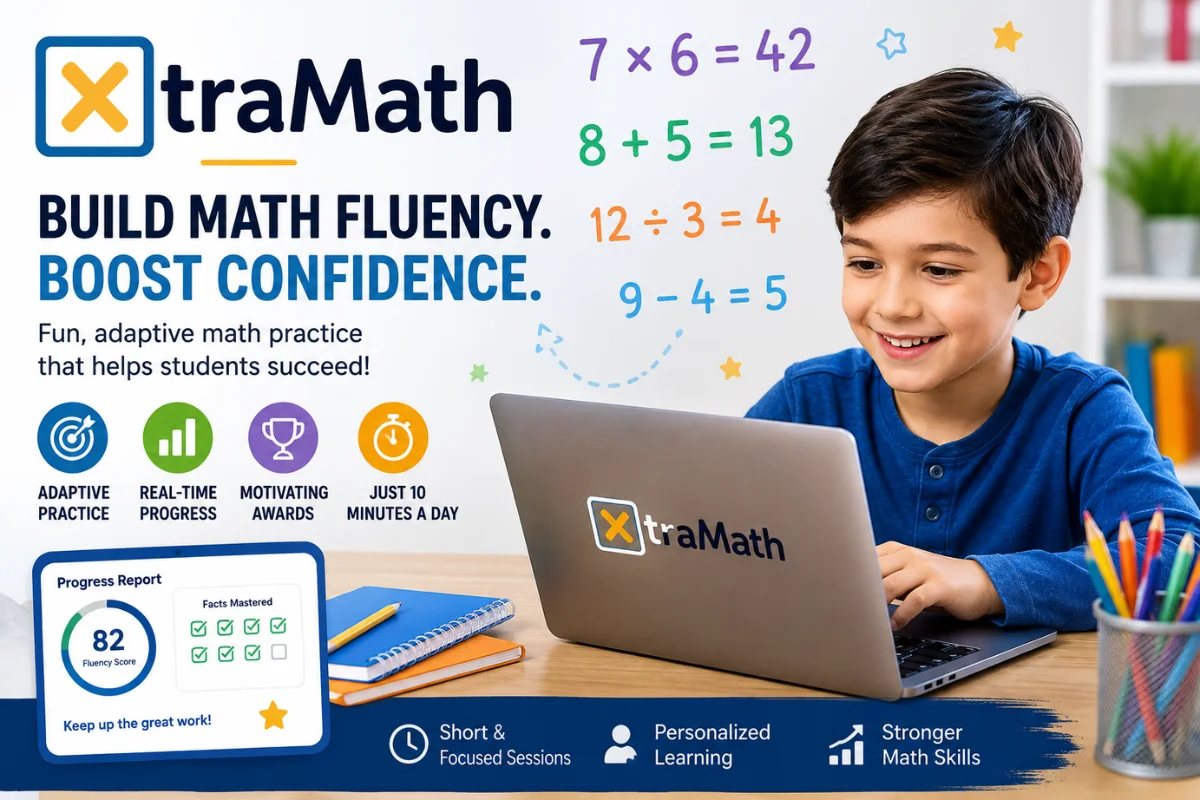
Math becomes much easier when students can recall basic facts without stopping to calculate every answer. Addition, subtraction, multiplication, and division form the foundation for many later mathematical skills. When these facts become automatic, students can spend more mental energy solving fractions, algebra problems, word problems, and other challenging tasks.
XtraMath is an online math fact fluency program designed to help students develop this automatic recall through short, regular practice sessions. Rather than attempting to teach every mathematical concept from the beginning, XtraMath focuses on helping learners become faster and more confident with basic arithmetic facts.
The platform is primarily designed for elementary students, particularly K–6 learners, although older students can also use it for review or intervention. Its approach combines assessment, personalized practice, progress tracking, and repetition.
What Is XtraMath?
XtraMath is an online learning program focused on math fact fluency. Its main goal is to help students recall basic arithmetic facts quickly and accurately.
The platform covers addition, subtraction, multiplication, and division. Students work through an organized progression rather than simply receiving a random collection of questions.
XtraMath is different from a traditional math lesson because it does not primarily teach students how to discover mathematical strategies. Instead, it is intended for students who already understand how to solve the problems and need additional practice to make their recall more automatic.
That distinction is important. A student who does not understand multiplication should first receive instruction and examples from a teacher or parent. XtraMath can then provide practice after the underlying concept is understood.
How Does XtraMath Work?
XtraMath uses short sessions and repeated practice to build fluency.
When a student begins, the program first evaluates their existing knowledge through placement activities. This gives the system a starting point and provides teachers or parents with a baseline for measuring future progress.
After placement, students typically complete a short progress quiz followed by practice activities. A regular session takes around 10 minutes or less, making it easier to include in a daily school or home routine.
The system also uses spaced repetition. Instead of giving every fact equal attention, it can emphasize facts that a student has not yet mastered.
This creates a more individualized practice experience.
The XtraMath Placement Quiz
New students begin with a placement process designed to determine their current level of fluency.
The placement is divided into short sessions rather than requiring students to complete one long test. According to XtraMath’s current student guidance, placement typically takes two to three days.
The result is an initial fluency score.
This score is not intended to be a school grade. Instead, it acts as a reference point that helps teachers and parents understand where the student started and how their performance changes over time.
This approach can be useful because two students in the same grade may begin with very different levels of arithmetic fluency.
Daily XtraMath Practice
After placement, students move into regular practice.
A typical session begins with a progress quiz. This short assessment checks whether students have retained facts they have previously practiced. Students then complete targeted activities designed to reinforce facts that still need work.
The short format is one of the platform’s most noticeable features.
Instead of asking students to spend a long period completing worksheets, XtraMath encourages a consistent daily routine. A few minutes of focused practice can be easier to fit into a classroom schedule or homework routine.
Consistency is particularly important because math fact fluency develops over repeated exposure rather than through one large practice session.
What Is the XtraMath Fluency Score?
The fluency score is one of the main tools used to monitor progress.
It represents a student’s performance within a particular mathematical operation. As students improve their recall, their score can increase. However, the score can also move up or down because it reflects recent quiz performance rather than simply recording everything a student has ever answered correctly.
A score of 100 represents mastery of the specific operation in the program.
Importantly, XtraMath explains that a fluency score should not be treated as a traditional grade. Students naturally progress at different speeds, and the score is designed to show development rather than rank students against one another.
Understanding the Fluency Matrix
The fluency matrix provides another way to understand a student’s progress.
Instead of looking only at one overall number, teachers and parents can see information about individual math facts. This can reveal which facts have become fluent and which ones still require practice.
For example, a student may be highly comfortable with basic addition facts but still struggle with certain multiplication combinations.
This detailed view can help an educator decide where additional instruction or practice may be useful.
XtraMath’s Practice Activities
One of the better-known practice activities is called Race the Teacher.
Students answer math facts while attempting to beat the teacher character. The activity is designed to make repetitive practice more engaging while encouraging students to improve their recall speed.
XtraMath selects a small group of facts for practice based on the student’s current needs. Spaced repetition is then used to reinforce those facts over time.
An important detail is that practice activities do not directly determine the fluency score. The score comes from progress quizzes, allowing the program to distinguish practice from assessment.
XtraMath Timer and Fluency Thresholds
Speed is an important part of fact fluency, but students do not all work at the same pace.
XtraMath therefore provides different fluency threshold settings. Current program options include several response-time levels, allowing educators to adjust the experience according to student needs.
For some learners, a longer threshold may provide additional comfort while they develop confidence. More advanced students may eventually work with shorter thresholds.
The timer can also be hidden when it creates unnecessary pressure for a particular student.
This flexibility matters because the goal should be confident recall, not simply making a student feel rushed.
Main XtraMath Features at a Glance
| Feature | What It Does | Why It Matters |
| Placement Quiz | Establishes a student’s starting level | Creates a baseline for progress |
| Progress Quiz | Measures retained knowledge | Shows ongoing development |
| Adaptive Practice | Focuses on selected facts | Provides targeted repetition |
| Fluency Score | Tracks operation-level progress | Helps monitor improvement |
| Fluency Matrix | Shows individual fact performance | Identifies strengths and gaps |
| Awards | Recognizes milestones | Provides motivation |
| Teacher Reports | Displays student performance | Supports classroom monitoring |
| Custom Programs | Allows settings to be adjusted | Helps meet different learning needs |
XtraMath Programs for Different Grade Levels
XtraMath offers suggested programs that align with grade-level progression.
The program structure can begin with foundational addition and gradually move through subtraction, multiplication, and division. Current guidance also includes programs aligned with Common Core and Texas TEKS expectations.
For example, beginning learners may start with basic addition facts. As they demonstrate fluency, they can progress to related subtraction work.
Older students can also use XtraMath for maintenance or intervention when they need additional practice with fundamental arithmetic.
Can Teachers Customize XtraMath?
Teachers can adjust programs based on student needs.
XtraMath’s current program settings allow educators to select operations, difficulty levels, fluency thresholds, and other options depending on the available program or license. Premium options provide additional customization compared with the standard sequence.
This can be useful in a classroom where students are working at different levels.
Instead of requiring every student to follow exactly the same progression, teachers can provide different practice paths where appropriate.
XtraMath for Parents
Parents can also use XtraMath to support regular practice at home.
The program can be useful as a short addition to an existing homework routine. Because sessions are relatively brief, families do not necessarily need to dedicate an entire evening to math fact practice.
Parents should still remember that XtraMath works best as a practice tool rather than a replacement for mathematical instruction.
If a child does not understand why an answer is correct, additional explanation, visual examples, manipulatives, or teacher guidance may be necessary before practicing the fact repeatedly.
Is XtraMath Free?
XtraMath offers a free version, while additional features are available through paid plans.
The current teacher information describes a Teacher Plan that provides broader access for schools and multiple teachers and students. Premium features can include enhanced reports, customization, out-of-school access, family reports, and printable resources.
The exact features available can depend on the type of account or license.
For families and educators, it is therefore worth checking the current official plan information before deciding which version is appropriate.
Recent Developments and Resources
XtraMath continues to expand the ways teachers can use the platform alongside classroom instruction.
The current teacher platform highlights adaptive practice, instant feedback, progress reporting, awards, and classroom tools. It also promotes Awakening, a curriculum-aligned game world from Legends of Learning that can be made available after a student completes their daily XtraMath fluency session.
The platform has also published resources designed around specific classroom goals. In March 2026, XtraMath published a four-week fluency sprint focused on preparing students for state math testing through regular diagnostic checks and daily fluency practice.
These developments show how the platform is increasingly positioned as part of a broader classroom routine rather than simply a standalone quiz website.
Benefits of Using XtraMath
There are several reasons teachers and families may find XtraMath useful.
Short Daily Sessions
The brief format makes it easier to create a consistent routine.
Targeted Practice
Students can spend more time on facts that need reinforcement rather than practicing everything equally.
Progress Monitoring
Teachers and parents can review scores and fact-level information to see how a student is developing.
Familiar Routine
The repeated structure can help younger students understand what they are expected to do each day.
Motivation
Trophies, certificates, and other milestones provide recognition as students progress.
What XtraMath Does Not Replace
Although XtraMath can be helpful, it should not replace complete math instruction.
Students need to understand mathematical concepts, strategies, patterns, and problem-solving techniques. Fact fluency is only one part of mathematics.
XtraMath itself recommends making sure students can solve problems without time pressure before using the program to build fluency.
For example, a student should understand what multiplication represents before being expected to rapidly recall multiplication facts.
This makes XtraMath more effective as a supplement to good instruction.
Tips for Getting Better Results With XtraMath
The most effective approach is usually consistency.
Encourage students to complete their practice regularly rather than attempting to compensate for missed sessions with one long practice period.
It is also important to pay attention to frustration. If a student becomes anxious because of the timer, an educator can consider adjusting the fluency threshold or hiding the timer when appropriate.
Parents and teachers should also celebrate improvement rather than focusing exclusively on reaching a particular score.
A student who moves from struggling with a group of facts to answering them confidently has made meaningful progress, even if their overall score is not yet perfect.
Final Thoughts
XtraMath provides a focused approach to developing basic math fact fluency. Its short sessions, progress quizzes, adaptive practice, fluency scores, and reporting tools make it suitable for classrooms and home learning routines.
The platform is most useful when students already understand the underlying mathematical concepts and need practice developing faster, more automatic recall.
For teachers, detailed progress information can help identify areas where students need additional support. For parents, the short daily format can make regular math practice easier to maintain.
Ultimately, XtraMath works best as one part of a broader mathematics education. Combined with strong instruction, problem-solving activities, hands-on learning, and regular practice, it can help students build the arithmetic foundation they need for more advanced mathematics.
