

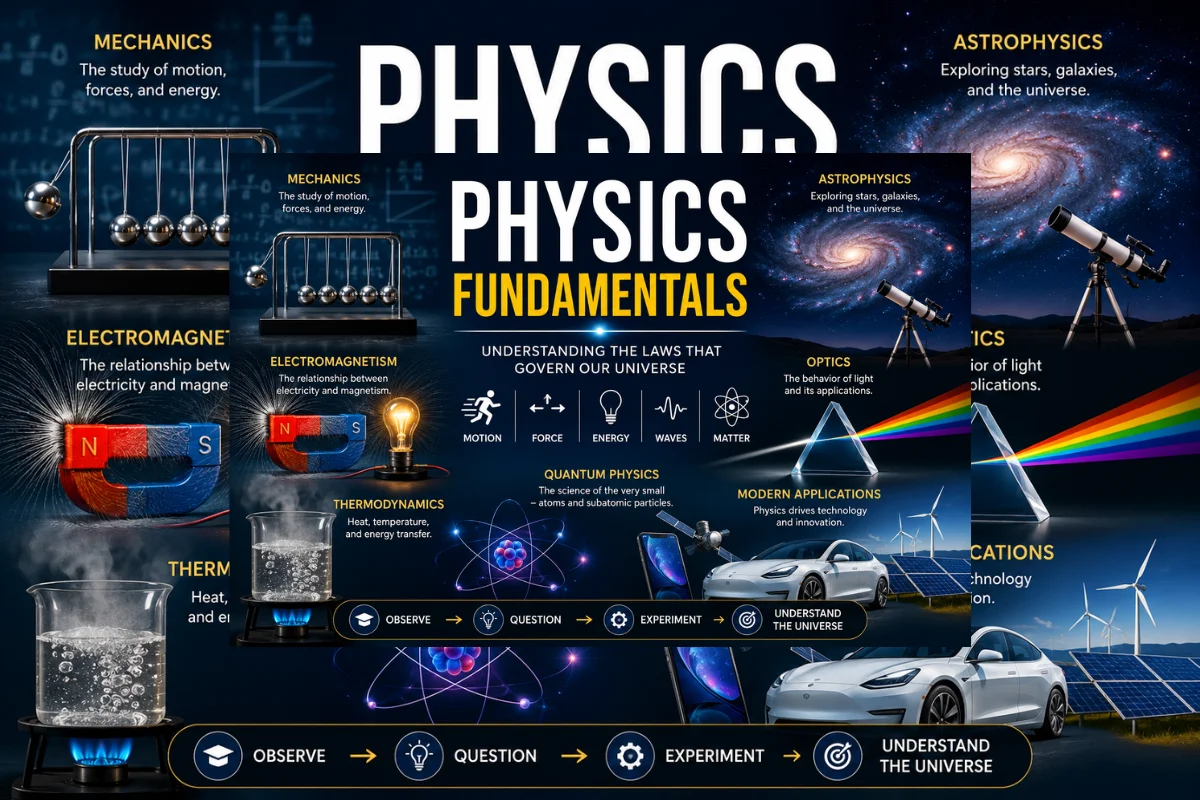
Physics is one of the most important branches of science because it helps us understand how the universe works. From the movement of planets and stars to the operation of smartphones and electric vehicles, physics explains the principles behind countless natural and technological phenomena.
The study of physics is built on observation, experimentation, and mathematical analysis. It seeks to answer fundamental questions about matter, energy, space, and time. While physics can seem complex at first, its core concepts are surprisingly connected to everyday experiences.
Whether you are a student beginning your scientific journey or someone interested in understanding the world more deeply, learning physics fundamentals provides a strong foundation for exploring modern science.
What Are Physics Fundamentals?
Physics fundamentals refer to the basic principles and concepts that form the foundation of physics.
These concepts help explain how objects move, how forces interact, how energy is transferred, and how matter behaves under different conditions.
Understanding these foundational ideas makes it easier to study advanced topics such as quantum mechanics, astrophysics, electronics, and nuclear physics.
Physics is often described as the science of matter, energy, motion, and the interactions between them.
Why Physics Matters
Physics plays a significant role in modern life.
Many technologies we use daily exist because of discoveries made by physicists. Computers, mobile phones, satellites, GPS systems, medical imaging devices, and renewable energy technologies all rely on fundamental physics principles.
Beyond technology, physics helps us understand natural events such as earthquakes, lightning, weather patterns, and the behavior of stars.
By studying physics, we gain valuable problem-solving skills and a deeper appreciation of the natural world.
The Major Branches of Physics
Physics is a broad field divided into several specialized branches.
Classical Mechanics
Classical mechanics studies the motion of objects and the forces acting upon them.
It explains how cars move, why balls fall, and how machines operate.
Thermodynamics
Thermodynamics focuses on heat, temperature, and energy transfer.
This branch helps engineers design engines, refrigerators, and power plants.
Electromagnetism
Electromagnetism examines electric and magnetic forces.
It forms the foundation of modern electronics, communication systems, and electrical engineering.
Optics
Optics studies light and its interactions with matter.
Applications include cameras, microscopes, telescopes, and fiber-optic communication systems.
Quantum Physics
Quantum physics investigates the behavior of particles at atomic and subatomic levels.
This field has revolutionized modern technology and scientific understanding.
Astrophysics
Astrophysics explores stars, galaxies, black holes, and the structure of the universe.
It combines astronomy with physical principles to explain cosmic phenomena.
Fundamental Concepts in Physics
Several core concepts serve as building blocks for understanding physics.
Matter
Matter refers to anything that has mass and occupies space.
Everything around us, including air, water, rocks, and living organisms, is made of matter.
Energy
Energy is the ability to perform work or cause change.
Energy exists in many forms, including:
- Kinetic energy
- Potential energy
- Thermal energy
- Electrical energy
- Chemical energy
- Nuclear energy
Force
A force is a push or pull acting on an object.
Forces can change an object’s speed, direction, or shape.
Motion
Motion describes the movement of an object relative to a reference point.
Understanding motion is one of the central goals of physics.
Time and Space
Time measures the sequence of events, while space provides the framework within which objects exist and move.
Together, they form the foundation of modern physical theories.
Key Physics Quantities and Units
| Physical Quantity | SI Unit | Symbol |
| Length | Meter | m |
| Mass | Kilogram | kg |
| Time | Second | s |
| Temperature | Kelvin | K |
| Force | Newton | N |
| Energy | Joule | J |
| Power | Watt | W |
| Electric Current | Ampere | A |
Understanding these units is essential for solving physics problems accurately.
Newton’s Laws of Motion
One of the most important topics in physics is Newton’s Laws of Motion.
First Law: Law of Inertia
An object remains at rest or continues moving at a constant velocity unless acted upon by an external force.
This principle explains why seat belts are necessary in vehicles.
Second Law: Force and Acceleration
The acceleration of an object depends on the force applied and its mass.
This relationship is expressed as:
F = ma
Where:
- F = Force
- m = Mass
- a = Acceleration
Third Law: Action and Reaction
For every action, there is an equal and opposite reaction.
Rocket launches provide a clear example of this law in action.
Understanding Energy
Energy is one of the most important concepts in physics.
It cannot be created or destroyed but can change from one form to another.
This principle is known as the Law of Conservation of Energy.
For example:
- A roller coaster converts potential energy into kinetic energy.
- A battery converts chemical energy into electrical energy.
- A solar panel converts light energy into electricity.
Energy transformations occur continuously in nature and technology.
Work and Power
Work
In physics, work occurs when a force moves an object over a distance.
The formula for work is:
Work = Force × Distance
Work is measured in joules.
Power
Power measures how quickly work is done.
The formula for power is:
Power = Work ÷ Time
Power is measured in watts.
Power calculations are essential in engineering and electrical systems.
Waves and Sound
Waves transfer energy without permanently moving matter.
There are two primary categories:
Mechanical Waves
Mechanical waves require a medium to travel.
Examples include:
- Sound waves
- Water waves
- Seismic waves
Electromagnetic Waves
Electromagnetic waves do not require a medium.
Examples include:
- Radio waves
- Microwaves
- Visible light
- X-rays
These waves play a critical role in communication and medical technologies.
Electricity and Magnetism
Electricity and magnetism are closely related forces.
Electric current occurs when charged particles move through a conductor.
Common applications include:
- Household appliances
- Computers
- Electric vehicles
- Industrial machinery
Magnetic fields influence moving charges and create the basis for motors and generators.
The relationship between electricity and magnetism forms the foundation of modern power systems.
Light and Optics
Light is an electromagnetic wave that allows us to see the world around us.
Optics examines how light behaves when it interacts with different materials.
Important optical phenomena include:
Reflection
Reflection occurs when light bounces off a surface.
Mirrors work through reflection.
Refraction
Refraction occurs when light changes direction while passing through different materials.
Eyeglasses and lenses rely on refraction.
Diffraction
Diffraction involves the bending of waves around obstacles.
This effect helps scientists study wave behavior.
The Atomic Structure of Matter
Modern physics reveals that matter consists of atoms.
Atoms contain:
- Protons
- Neutrons
- Electrons
These particles interact through fundamental forces.
Understanding atomic structure has led to advances in chemistry, medicine, electronics, and materials science.
Research into atomic and subatomic particles continues to expand scientific knowledge.
Modern Physics and Emerging Discoveries
Physics continues evolving through ongoing research and innovation.
Scientists are exploring areas such as:
Quantum Computing
Quantum computers use quantum principles to solve complex problems faster than traditional computers.
Artificial Intelligence in Physics
AI is increasingly helping researchers analyze large datasets and discover patterns.
Renewable Energy Technologies
Physics drives innovations in solar energy, battery storage, and sustainable power generation.
Space Exploration
Advances in rocket technology and astrophysics continue expanding our understanding of the universe.
These developments demonstrate how physics remains at the center of scientific progress.
Physics in Everyday Life
Many people use physics without realizing it.
Examples include:
- Riding a bicycle
- Cooking food
- Driving a car
- Using a smartphone
- Watching television
- Flying on airplanes
Each activity involves physical principles such as motion, energy transfer, electricity, and forces.
Recognizing these connections makes physics more relatable and easier to understand.
Common Challenges for Physics Students
Many students find physics challenging because it combines mathematics with scientific reasoning.
Common difficulties include:
Mathematical Calculations
Physics often requires algebra and problem-solving skills.
Abstract Concepts
Topics such as relativity and quantum mechanics can seem difficult to visualize.
Unit Conversions
Accurate calculations depend on consistent units.
Applying Theory
Students sometimes struggle to connect formulas with real-world situations.
Regular practice and conceptual understanding help overcome these challenges.
Tips for Learning Physics Effectively
Students can improve their understanding by following several strategies.
Focus on Concepts First
Understand the underlying principles before memorizing formulas.
Practice Regularly
Problem-solving strengthens both mathematical and conceptual skills.
Visualize Physical Processes
Diagrams and animations can make complex topics easier to understand.
Relate Physics to Daily Life
Connecting concepts to real-world experiences improves retention.
Stay Curious
Physics rewards curiosity and exploration.
Asking questions often leads to deeper understanding.
Conclusion
Physics fundamentals provide the framework for understanding the universe and the countless phenomena that shape our daily lives. From motion and forces to energy, electricity, light, and atomic structure, these core principles explain how nature operates at every scale.
The importance of physics extends far beyond classrooms and laboratories. It drives technological innovation, supports scientific discovery, and helps solve some of humanity’s most pressing challenges. As new advancements emerge in fields such as quantum computing, renewable energy, and space exploration, physics continues to remain at the forefront of progress.
By mastering the fundamentals, students and enthusiasts gain valuable analytical skills and a deeper appreciation for the laws that govern the world around us.
Meta Description (130 Characters):
Learn Physics Fundamentals, including motion, forces, energy, waves, electricity, and modern scientific concepts.
