

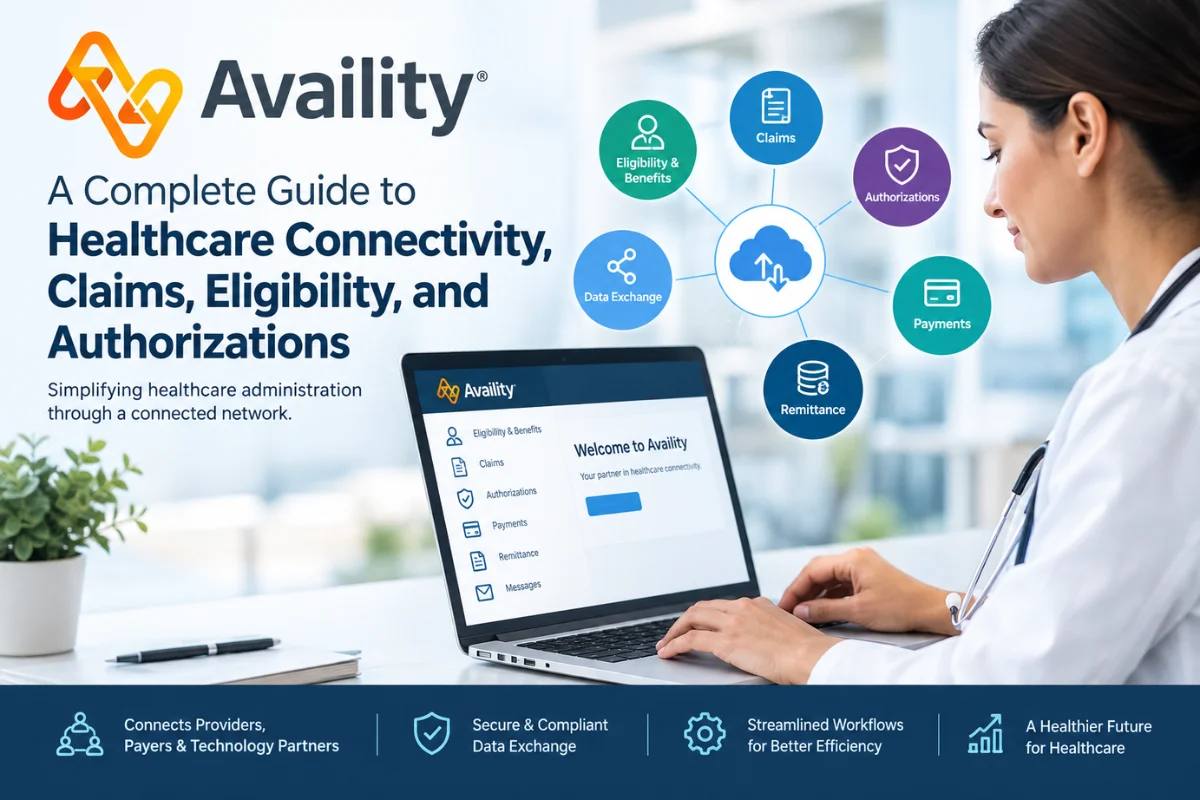
Healthcare administration involves much more than patient care. Medical practices, hospitals, insurance companies, and healthcare technology providers must constantly exchange information about eligibility, claims, authorizations, payments, and clinical documentation.
When these activities depend on separate systems, phone calls, emails, and manual data entry, administrative work can become complicated. Availity is designed to bring many of these interactions into connected digital workflows.
Availity operates a large healthcare information network that connects providers, health plans, and healthcare technology companies. Its solutions support important administrative and financial activities, including eligibility verification, claims, prior authorizations, remittances, and data exchange. Availity currently says its network facilitates more than 13 billion clinical, administrative, and financial transactions each year.
What Is Availity?
Availity is a healthcare technology company focused on connecting different parts of the healthcare ecosystem. Its network allows healthcare providers and other organizations to exchange information electronically with participating health plans.
The platform is particularly useful for administrative tasks that occur before and after a patient receives care. These can include checking insurance coverage, determining authorization requirements, submitting claims, checking claim status, and reviewing payment information.
Instead of maintaining separate workflows for every payer, providers can use Availity’s multi-payer environment to access supported transactions from a centralized platform.
This approach can make routine administrative work more organized while reducing dependence on manual communication.
How Does Availity Work?
At a basic level, Availity acts as a connectivity layer between healthcare providers, payers, and technology systems.
For example, a medical office may need to confirm whether a patient’s insurance is active before an appointment. After the service is provided, the same organization may need to submit a claim and later check whether that claim has been processed.
If authorization is required, additional documentation may also need to be submitted to the health plan.
Availity provides digital tools that support these steps. Its network also supports electronic healthcare transactions and integration options for technology companies and other trading partners.
For organizations that need deeper integration, Availity supports APIs and healthcare interoperability technologies. Its current prior authorization connectivity work includes FHIR-based workflows involving coverage requirements discovery, documentation collection, and authorization submission.
Availity Essentials for Healthcare Providers
Availity Essentials is one of the best-known products in the Availity ecosystem.
It is a multi-payer provider portal that gives participating healthcare organizations a single place to perform various administrative transactions. The exact services available depend on the health plans connected to the provider’s account.
Common activities include checking eligibility and benefits, submitting claims, checking claim status, requesting authorizations, viewing remittance information, and receiving payer communications.
The multi-payer model can be useful for practices that work with several insurance companies. Instead of learning a completely different process for every payer, staff can use a common environment for supported transactions.
Availity also uses role-based access, allowing organizations to assign appropriate permissions according to a user’s responsibilities.
Checking Patient Eligibility and Benefits
Eligibility verification is an important part of the healthcare revenue cycle.
Before providing certain services, providers need to know whether a patient has active coverage and what benefits may apply. Incorrect or outdated insurance information can create billing problems later.
Availity provides eligibility and coverage solutions for small medical practices as well as larger healthcare organizations.
Through Availity Essentials and Essentials Plus, providers can check eligibility and benefits for participating payers. Larger organizations can use more advanced solutions, including batch and integrated real-time eligibility capabilities.
Real-time verification can be particularly useful when insurance information needs to be checked close to the time of service.
It can also help staff identify potential coverage issues earlier, rather than discovering them after a claim has already been submitted.
Claims Submission Through Availity
Claims are a central part of the healthcare payment process.
Once a provider delivers a service, the appropriate billing information must reach the health plan. The payer then processes the claim and determines whether it should be paid, rejected, denied, or otherwise handled.
Availity provides electronic claim submission tools for participating payers. Providers can submit claims through supported workflows and monitor claim status afterward.
For smaller practices, web-based claim forms can provide a relatively straightforward way to submit professional or institutional claims without requiring a large practice management system. Essentials Plus extends access to additional payers through a subscription-based model.
For larger organizations, Availity Essentials Pro provides broader revenue cycle capabilities designed to connect pre-service, post-service, and post-adjudication activities.
Understanding Claim Status
Submitting a claim is only one step in the revenue cycle.
Billing teams also need to know what happens after submission. A claim may be accepted, processed, pended, denied, or paid, depending on the circumstances.
Availity provides claim-status functionality through its provider solutions. This gives staff a way to review available processing information without relying entirely on phone calls to health plans.
Centralized claim-status information can help billing teams identify outstanding claims and determine which accounts may require additional action.
The actual information available can vary depending on the payer and transaction type, so providers should review the supported payer list and applicable workflows.
Prior Authorization With Availity
Prior authorization can be one of the more complicated administrative steps in healthcare.
Some health plans require providers to obtain approval before certain procedures, treatments, medications, or other services are provided. The provider may also need to submit clinical documentation to support the request.
Availity’s authorization tools allow providers to check whether authorization is required, create requests, attach supporting documentation, and monitor pending requests through a centralized workflow.
This can reduce the need to manage authorization requests through multiple disconnected channels.
Availity is also expanding its technology around electronic prior authorization. Its current connectivity documentation describes workflows that can determine authorization requirements, collect documentation, and submit requests using FHIR-based processes.
How Prior Authorization Can Be Managed
A typical digital authorization workflow may include several stages:
- Determine whether authorization is required.
- Collect the necessary patient and service information.
- Gather supporting medical documentation.
- Submit the authorization request.
- Monitor the request status.
- Respond to additional documentation requests when necessary.
- Receive and review the payer’s decision.
The exact process depends on the payer, service, and technology configuration.
Availity and Healthcare Payments
Healthcare administration does not end when a claim is processed.
Providers also need access to remittance and payment information so their billing teams can reconcile accounts and understand how claims were adjudicated.
Availity Essentials supports remittance-related workflows for participating health plans. Providers can access electronic remittance information and use it alongside other claims and payment activities.
Having claims, status information, and remittance data available within connected workflows can make it easier for revenue cycle teams to follow an account from submission through payment.
Common Availity Workflows
| Healthcare Workflow | How Availity Can Support It |
| Eligibility and benefits | Verify coverage and available benefits |
| Claims submission | Submit supported electronic claims |
| Claim status | Review available processing information |
| Prior authorization | Check requirements, submit requests, and track status |
| Medical attachments | Submit supporting documentation where supported |
| Remittance | Access electronic payment and remittance information |
| Payer communication | Receive messages, notifications, and payer information |
| Data integration | Connect healthcare systems through supported technologies |
Availity Essentials vs. Essentials Plus
Not every provider has the same connectivity requirements.
Availity Essentials is a health-plan-sponsored multi-payer portal that provides access to supported transactions. Essentials Plus is a subscription-based option designed to give individual practitioners and smaller practices access to additional payers and capabilities.
The difference is important for practices that work with health plans outside the group available through their sponsored Essentials access.
Before choosing a workflow, providers should check the current Availity payer list and confirm which transactions are supported for each health plan.
Availity for Larger Healthcare Organizations
Hospitals and larger healthcare systems often have more complex revenue cycle requirements.
They may need to process large volumes of eligibility inquiries, claims, attachments, authorizations, and payment transactions while integrating those activities with electronic health record systems.
Availity Essentials Pro is designed for these more advanced requirements. Its capabilities include real-time and batch eligibility solutions, revenue cycle management, claim processing, and prior authorization functionality.
Integration can also allow information to move more directly between healthcare systems and administrative workflows, reducing unnecessary manual entry.
Availity for Healthcare Technology Companies
Availity is not limited to provider-facing portal functionality.
Healthcare technology vendors, clearinghouses, and other partners can connect with Availity to exchange transactions with participating payers.
The company provides integration options that include APIs and established healthcare transaction standards. Its registration resources specifically identify software companies, trading partners, billing services, and developers as groups that can connect with the network.
This makes Availity relevant to organizations building healthcare applications as well as those directly delivering medical services.
Recent Developments in Prior Authorization Connectivity
One notable area of ongoing development is electronic prior authorization.
Availity’s 2026 technical documentation shows continued updates to its Prior Authorization Connectivity Hub. The revision history records multiple updates during 2026, including a September 16, 2026 revision that added a DTR application section and updated DTR, FAQ, PAS, and environment information.
These developments reflect the industry’s broader move toward structured digital workflows rather than relying entirely on fax, phone, and manual documentation.
The goal is to make authorization information available closer to the point of care while allowing required documentation to move electronically between systems.
Benefits of Using Availity
The main advantage of a connected healthcare network is reducing unnecessary administrative fragmentation.
A provider may work with numerous health plans, and each payer can have different requirements. A multi-payer platform can provide a more consistent starting point for common administrative tasks.
Availity also brings several related workflows together. Eligibility, authorizations, claims, claim status, remittance, and communication can be managed through connected services rather than completely separate processes.
For larger organizations, integration and automation can further reduce repetitive work.
However, the benefits depend on payer participation, available transactions, organizational setup, and the specific Availity product being used.
Things Providers Should Know Before Using Availity
Availity does not mean every health plan transaction will be identical.
Available features can differ by payer. Some services may be available through Essentials, while others may require Essentials Plus, Essentials Pro, an integrated solution, or another supported connection.
Providers should therefore confirm the payer list and transaction requirements before changing an established billing workflow.
User access and permissions should also be configured carefully. Availity’s provider environment uses role-based access, allowing organizations to give users access according to their responsibilities.
Final Thoughts
Availity plays an important role in connecting healthcare providers, health plans, and technology companies through electronic administrative and financial workflows.
For providers, its services can support everyday tasks such as insurance verification, claims submission, claim-status tracking, prior authorization, and payment information.
Its broader technology platform also supports API-based connectivity and newer digital approaches to healthcare interoperability.
As healthcare administration becomes increasingly digital, connected networks such as Availity can help organizations move information between systems more efficiently. The most appropriate solution, however, depends on the provider’s size, payer relationships, transaction requirements, and existing technology environment.
For any organization considering Availity, checking the current payer availability and supported transactions is an important first step before building or changing a workflow.
