

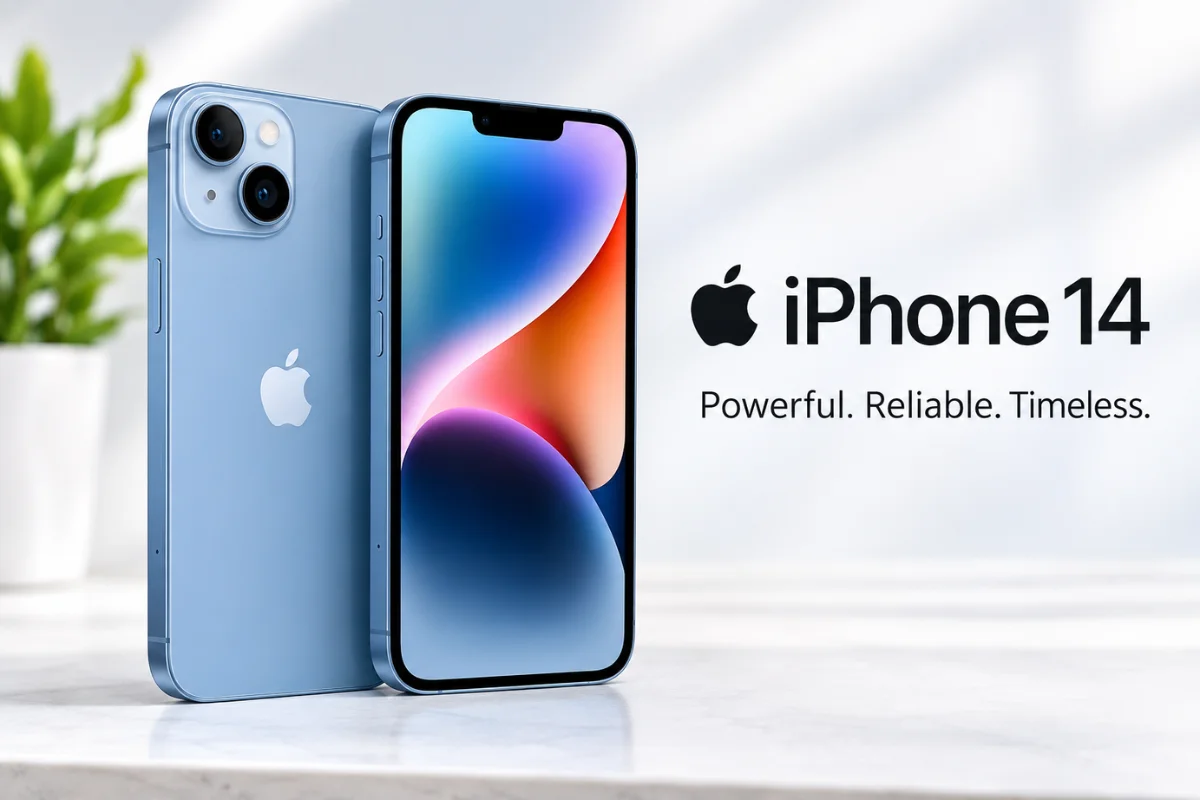
The iPhone 14 remains a popular choice for people who want a premium smartphone with a reliable camera, smooth performance, and Apple’s familiar iOS experience. Although Apple introduced the device in 2022, its combination of a compact design, powerful processor, and long-term software support keeps it relevant for everyday smartphone users.
The iPhone 14 offers a 6.1-inch OLED display, an A15 Bionic chip, a dual-camera system, and 5G connectivity. It also includes features such as Crash Detection, Emergency SOS via satellite, and improved photography capabilities. Whether you are considering a new device or a used iPhone, understanding its specifications and practical performance can help you make an informed decision.
This complete guide explores the iPhone 14’s design, display, cameras, battery, software, storage, and important buying considerations.
iPhone 14 Overview
The iPhone 14 was introduced in September 2022 as part of Apple’s iPhone 14 lineup. It was designed for users who wanted a powerful smartphone without the larger size or premium pricing associated with the Pro models.
The phone features a familiar flat-edge aluminum frame, a glass back, and a Ceramic Shield front. Its 6.1-inch size makes it comfortable for browsing, messaging, photography, and watching videos.
Apple offered the iPhone 14 in several colors, including Midnight, Purple, Starlight, (PRODUCT)RED, Blue, and Yellow. Storage options include 128GB, 256GB, and 512GB, giving buyers different choices based on their needs.
One of the main reasons people consider the iPhone 14 is its balance of performance and design. It does not include every feature found on newer iPhones, but it provides a strong foundation for everyday use.
Design and Build Quality
The iPhone 14 has a modern appearance with flat edges and rounded corners. Its aluminum frame keeps the phone relatively light, while the glass front and back give it a premium finish.
The device measures approximately 146.7mm in height, 71.5mm in width, and 7.8mm in thickness. It weighs around 172 grams, making it easy to carry in a pocket or use with one hand.
The Ceramic Shield front is designed to improve durability against accidental drops. However, no glass smartphone is completely resistant to damage, so a protective case and screen protector can still be useful.
The iPhone 14 also carries an IP68 rating for water and dust resistance under controlled laboratory conditions. Apple specifies protection in up to 6 meters of water for 30 minutes. This does not mean the phone is waterproof, and water resistance can decrease over time.
Available Colors
- Midnight
- Purple
- Starlight
- Blue
- Yellow
- (PRODUCT)RED
These color options allow buyers to choose between a subtle appearance and a more noticeable finish. The overall design remains recognizable as an Apple smartphone, with a clean back and a square camera module.
Display and Viewing Experience
The iPhone 14 comes with a 6.1-inch Super Retina XDR OLED display. It offers a resolution of 2532 × 1170 pixels at 460 pixels per inch, producing sharp text and detailed images.
OLED technology allows the screen to display deep blacks and strong contrast. This makes movies, photos, social media posts, and games look vibrant.
The display also supports HDR, True Tone, and a wide P3 color range. True Tone adjusts the screen’s color appearance to match surrounding lighting, which can make reading more comfortable in different environments.
Apple lists typical brightness of up to 800 nits and HDR peak brightness of up to 1,200 nits. These specifications help the screen remain useful in bright conditions, although direct sunlight can still affect visibility.
Is the Display Good for Everyday Use?
For browsing websites, watching YouTube, using WhatsApp, and reading articles, the iPhone 14 display remains capable. The OLED panel offers a premium viewing experience, and the 6.1-inch size provides a good balance between screen space and portability.
One limitation is that the standard iPhone 14 has a 60Hz refresh rate. Newer phones and some competing models offer higher refresh rates, which can make scrolling and animations feel smoother. The iPhone 14 still provides responsive everyday performance, but buyers who specifically want a high-refresh-rate display should consider this difference.
Performance and A15 Bionic Chip
The iPhone 14 is powered by Apple’s A15 Bionic chip. It includes a 6-core CPU, a 5-core GPU, and a 16-core Neural Engine.
This processor is capable of handling common smartphone tasks such as:
- Social media and messaging
- Web browsing
- Video streaming
- Photo editing
- Mobile gaming
- Multitasking
- Everyday productivity applications
The A15 Bionic was a powerful chip when the iPhone 14 launched, and it continues to provide a smooth experience for many users.
Apps generally open quickly, and the phone can handle demanding tasks without feeling sluggish under normal conditions. Gaming performance depends on the title and graphics settings, but the processor is suitable for many popular mobile games.
Performance for Long-Term Use
The iPhone 14 is also relevant for buyers who want to keep a phone for several years. Apple’s software support helps extend the useful life of its devices.
As of September 2026, Apple lists the iPhone 14 among the models compatible with iOS 27. This confirms that the device continues to receive support for the latest major iOS release listed by Apple. Future updates and individual features may vary by model and region.
Camera Features and Photography
The iPhone 14 features a dual-camera system on the back. It includes a 12MP Main camera and a 12MP Ultra Wide camera.
The Main camera has an ƒ/1.5 aperture and sensor-shift optical image stabilization. The Ultra Wide camera provides a 120-degree field of view, which is useful for landscapes, group photos, and wider scenes.
Apple also includes its Photonic Engine, Deep Fusion, Smart HDR 4, and Night mode technologies. These features are designed to improve image quality in different lighting conditions.
Main Camera
The 12MP Main camera is suitable for everyday photography. It can capture portraits, food photos, travel images, and social media content with good detail and natural-looking colors.
Optical image stabilization helps reduce the effect of small hand movements, particularly when taking photos in lower light or recording video while walking.
Ultra Wide Camera
The Ultra Wide camera allows you to capture more of a scene without moving far away from your subject.
It can be useful for:
- Architecture and buildings
- Travel photography
- Large groups
- Scenic landscapes
- Indoor photography
The Ultra Wide camera provides a different perspective from the Main camera and adds flexibility to the photography experience.
Front Camera and Video Recording
The iPhone 14 includes a 12MP TrueDepth front camera with autofocus. It is designed for selfies, video calls, and Face ID.
The phone supports 4K video recording at up to 60 frames per second, along with features such as Cinematic mode and Action mode. These tools can help users create more stable and engaging videos.
For people who frequently post videos on social media, the camera system remains a useful part of the iPhone 14 experience.
Battery Life and Charging
Battery performance is an important consideration when buying any smartphone. Apple rates the iPhone 14 for up to 20 hours of video playback, up to 16 hours of streamed video playback, and up to 80 hours of audio playback under its stated testing conditions. Actual battery life depends on settings, network use, apps, and battery health.
The phone supports MagSafe wireless charging up to 15W and Qi wireless charging up to 7.5W. It can also reach up to 50% charge in around 30 minutes with a 20W adapter or higher, according to Apple’s specifications.
What Affects Battery Performance?
Battery life can vary depending on:
- Screen brightness
- Mobile data and 5G usage
- Gaming
- Video recording
- Background applications
- Battery health
- Software version
A new or well-maintained battery may provide a different experience from a heavily used second-hand device. If you are buying a used iPhone 14, checking the battery health is especially important.
iPhone 14 Specifications Table
| Feature | iPhone 14 Specifications |
|---|---|
| Release Year | 2022 |
| Display | 6.1-inch Super Retina XDR OLED |
| Resolution | 2532 × 1170 pixels |
| Processor | Apple A15 Bionic |
| CPU | 6-core |
| GPU | 5-core |
| Rear Cameras | 12MP Main + 12MP Ultra Wide |
| Front Camera | 12MP TrueDepth |
| Storage | 128GB, 256GB, 512GB |
| Video Recording | Up to 4K at 60fps |
| Network | 5G |
| Wi-Fi | Wi-Fi 6 |
| Bluetooth | Bluetooth 5.3 |
| Water Resistance | IP68 |
| Charging | MagSafe up to 15W |
| Weight | 172 grams |
| Operating System | iOS |
| Face Recognition | Face ID |
Software and iOS Support
The iPhone 14 runs Apple’s iOS operating system, which provides access to the App Store, iCloud, FaceTime, Apple Pay where available, and a range of built-in apps.
iOS is known for its consistent interface and integration with other Apple products. Users who already have a Mac, Apple Watch, or AirPods may find the ecosystem convenient.
Latest Software Support
Apple’s current compatibility information lists the iPhone 14 as compatible with iOS 27. The iOS 27 release includes new features across supported iPhone models, but feature availability depends on the device, region, language, and other requirements.
The iPhone 14 should not be confused with newer iPhone models that have additional hardware capabilities. Software compatibility does not mean every feature is available on every device.
To check for updates, open Settings, select General, and then tap Software Update.
Connectivity and Safety Features
The iPhone 14 supports 5G, Wi-Fi 6, Bluetooth 5.3, and NFC. These technologies help with fast mobile connectivity, wireless accessories, and compatible payment features.
The phone also includes Face ID, which uses the TrueDepth camera system for facial recognition. It can be used to unlock the device and authenticate supported purchases and apps.
Apple introduced important safety features with the iPhone 14 series, including Crash Detection and Emergency SOS via satellite in supported regions.
Crash Detection is designed to detect certain severe car crashes and assist with emergency calls. Emergency SOS via satellite can help users contact emergency services in supported locations where cellular or Wi-Fi connectivity is unavailable.
Availability depends on the country, region, and service requirements. Users should check local support before relying on satellite-based safety features.
iPhone 14 Storage Options
Apple offers three storage capacities for the iPhone 14:
128GB
The 128GB model is suitable for users who mainly use messaging apps, social media, browsing, and occasional photography. It can be a practical option for people who regularly manage their photos and videos through cloud storage.
256GB
The 256GB version provides more space for photos, videos, games, and applications. It is a useful middle option for people who want additional storage without choosing the largest capacity.
512GB
The 512GB model is designed for users who store a large amount of content on their phones. It may appeal to people who record lots of videos, download games, or prefer keeping files locally.
Storage needs depend on personal usage. Choosing the right capacity can help avoid running out of space later.
iPhone 14 vs Newer iPhones
The iPhone 14 remains capable, but newer models may offer improvements in processing power, cameras, battery efficiency, charging, and display technology.
The standard iPhone 14 does not have the Dynamic Island found on newer standard iPhone models such as the iPhone 15. It also uses a Lightning port rather than USB-C.
The iPhone 14 can still be a practical choice for someone who wants a familiar Apple experience without requiring every new feature. However, people who prioritize newer hardware should compare it with more recent models before buying.
Is the iPhone 14 Worth Buying?
The iPhone 14 offers a combination of strong performance, a quality OLED display, dependable cameras, and ongoing software compatibility.
It may suit users who want:
- A compact premium smartphone
- Reliable everyday performance
- A good camera for photos and videos
- Access to Apple’s iOS ecosystem
- 5G connectivity
- A phone that continues to receive software updates
However, buying decisions should also consider price, battery health, warranty, storage, and the condition of the device.
For used iPhone buyers, it is important to check whether the phone is genuine, whether Face ID works, whether the screen has been replaced, and whether the battery is in good condition.
Final Thoughts
The iPhone 14 remains a capable smartphone with a balanced design and useful features. Its A15 Bionic processor, OLED display, dual-camera system, and iOS support make it suitable for many everyday tasks.
While newer iPhones offer additional technologies and improvements, the iPhone 14 continues to provide a premium smartphone experience. Its value depends on the price, condition, storage capacity, and the features that matter most to the buyer.
For users who want a reliable iPhone for photography, social media, entertainment, and daily productivity, the iPhone 14 remains a model worth understanding before making a purchase.
