

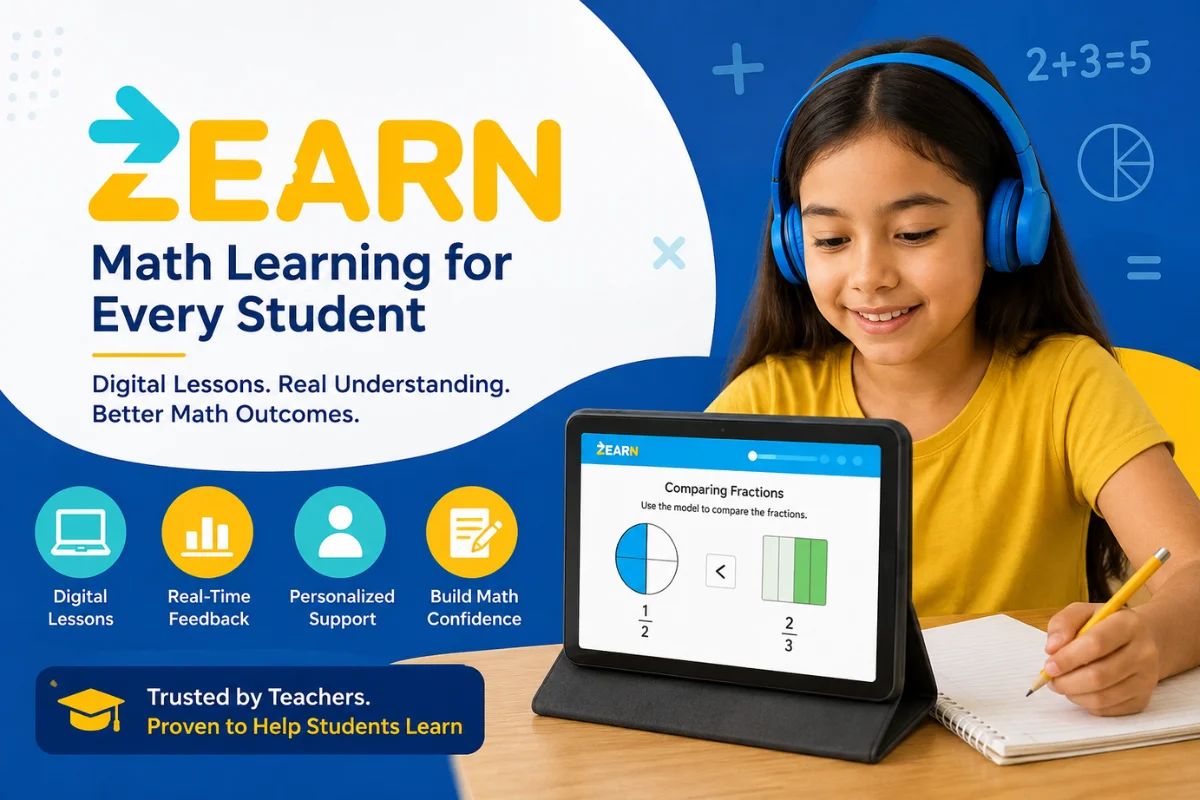
Math can be challenging for students when lessons move too quickly or when they do not fully understand an important concept. Zearn is designed to make grade-level math easier to understand by combining teacher-led instruction with interactive digital lessons, guided practice, and personalized support.
Zearn Math is a nonprofit learning platform focused on mathematics for students in kindergarten through eighth grade. Rather than replacing classroom teaching, the platform is designed to reinforce what students are already learning with their teachers. It gives students additional opportunities to practice concepts, solve problems, and build confidence.
The platform currently offers more than 1,000 digital lessons covering major K–8 math concepts. Its lessons combine online activities with paper-and-pencil problem solving, helping students move beyond simply clicking through questions on a screen.
What Is Zearn?
Zearn is an online math learning platform created to support students as they learn grade-level mathematics. It can be used during classroom instruction, intervention periods, tutoring, summer programs, and other structured learning settings.
One of the main ideas behind Zearn is that technology should support teachers rather than replace them. Students work through digital lessons connected to the math concepts being taught in class.
The platform uses a structured sequence called Missions. Teachers select the Mission that matches the concepts students are studying, and learners work through the lessons at their own pace.
Zearn is also designed around the concrete-to-pictorial-to-abstract approach. Students may begin with objects or visual models, move toward representations of mathematical ideas, and eventually work with more abstract numbers and equations.
How Does Zearn Work?
Zearn follows a consistent lesson structure so students know what to expect. Instead of presenting a large amount of information at once, lessons break mathematical ideas into manageable steps.
A typical digital learning experience can include:
- Fluency activities
- Guided instruction
- Interactive visual models
- Independent problem solving
- Real-time feedback
- Paper-and-pencil work
- Mastery-based practice
This structure gives students opportunities to learn a concept, practice it, and demonstrate that they understand it.
When a student struggles, Zearn can provide additional support within the grade-level lesson. This is important because students do not necessarily need to leave grade-level content just because they have unfinished learning from an earlier concept.
Key Features of Zearn Math
| Feature | How It Helps Students |
| Digital lessons | Gives students guided opportunities to learn and practice math |
| Interactive models | Makes abstract concepts easier to visualize |
| Adaptive support | Provides additional help when students struggle |
| Fluency practice | Builds speed and accuracy with essential math skills |
| Paper-and-pencil work | Encourages students to explain and apply their thinking |
| Mastery-based practice | Requires students to demonstrate understanding |
| Teacher reports | Helps teachers monitor progress and identify challenges |
| Missions | Organizes learning into connected grade-level concepts |
Zearn Missions and Grade-Level Learning
Missions are an important part of the Zearn experience. They organize lessons around mathematical concepts and provide a logical sequence for learning.
Instead of allowing students to randomly jump between unrelated topics, Zearn guides them through connected lessons. This helps create continuity between classroom teaching and independent digital work.
The platform covers every major math concept across grades K–8 through more than 1,000 digital lessons. Its content draws from established open educational resources, including Eureka Math for K–5 and Open Up Resources/Illustrative Mathematics for grades 6–8.
This approach can be particularly useful when teachers want students to practice the same concepts they are learning during regular instruction.
Interactive Digital Lessons
A major advantage of Zearn is that its lessons are designed to be interactive rather than simply asking students to watch long instructional videos.
Students can work with visual models, respond to questions, and solve problems during the lesson. Short instructional segments give learners opportunities to stop and apply what they have just learned.
The platform also provides feedback as students work. When a learner gets stuck, built-in support can help break down the problem and encourage another attempt.
Zearn says its adaptive support has been informed by data from more than six billion completed problems on the platform.
The Importance of Paper-and-Pencil Work
Although Zearn is a digital platform, it does not rely entirely on screen-based learning.
Paper-and-pencil problem solving is built into its lessons. Students may be asked to write their work, explain their thinking, or complete an exit ticket.
This combination matters because mathematical understanding involves more than selecting the correct answer. Writing down calculations and working through problems can help students develop stronger habits and recognize how mathematical ideas connect.
Zearn’s lesson design therefore combines digital interaction with offline problem solving.
How Zearn Helps Students Who Struggle With Math
One of the most useful aspects of Zearn is its approach to unfinished learning.
A student may struggle with multiplication, fractions, place value, or another foundational skill while the class is already studying a more advanced concept. Traditional remediation can sometimes move that student away from grade-level learning.
Zearn takes a different approach. When students experience difficulty, the platform can provide just-in-time support related to the skill they need.
These supports can include additional explanations, scaffolding, and opportunities to work through prerequisite concepts. Students can then return to the grade-level task rather than being permanently moved into unrelated remedial material.
Zearn for Teachers
Zearn is not only a student learning platform. It also provides teachers with tools for monitoring student progress.
Teachers can view reports that provide information about student activity, progress, pace, and areas where learners may be experiencing difficulty.
These insights can make it easier to identify students who need additional attention. Instead of waiting until the end of a unit or test to discover a problem, teachers can use available information during learning to decide where support may be useful.
Zearn also provides instructional and printable resources that teachers can use alongside digital lessons.
New LiveView Features for the 2026–27 School Year
One notable update for the 2026–27 school year is Zearn’s LiveView classroom report.
According to Zearn’s current educator resources, LiveView gives teachers real-time visibility into student activity while students are working on Zearn. Teachers can see what students are doing and identify situations where learners may need encouragement or support.
This type of real-time information can make digital learning more connected to classroom instruction. Rather than treating online practice as a separate activity, teachers can use the information to respond while students are actively learning.
Is Zearn Free?
Zearn provides free access for teachers and students in certain settings. Its nonprofit model is a major part of the platform’s identity.
According to Zearn, teachers can access the digital lessons for one classroom of up to 35 students at no cost. Schools and districts can also purchase accounts with additional features and support for larger-scale implementation.
This makes Zearn accessible to individual educators while also giving schools and districts options for broader adoption.
Zearn and Accessibility
A digital learning platform needs to work for students with different learning needs. Zearn includes several features intended to make its lessons more accessible.
Current Zearn materials mention features such as:
- Closed captions
- Text-to-speech audio support
- An on-screen keypad
- Zoom functionality
- The ability to rewind instructional content
These tools can help more students participate in digital lessons and engage with mathematical explanations in ways that suit their needs.
Zearn for Parents and Families
Parents can also use Zearn as a way to understand what their children are learning in mathematics.
Because the platform follows structured grade-level content, families can use it to provide additional practice without randomly selecting unrelated math topics.
However, Zearn works best when students use it with a clear learning purpose. It is not simply a game or entertainment platform. Students are expected to think, solve problems, write their work, and demonstrate understanding.
Parents can support children by creating a consistent study routine and encouraging them to explain how they reached an answer rather than focusing only on whether the answer is correct.
Does Zearn Use AI?
Artificial intelligence has become increasingly common in educational technology, but Zearn’s current approach is notably structured.
Zearn states that its student-facing lessons do not use generative AI chatbots or AI-generated responses. The platform instead relies on structured lessons, adaptive pathways, instructional support, and its existing learning design. Zearn also states that it does not share personal student data with AI models.
For educators and parents who prefer learning environments where students actively work through problems instead of relying on chatbot-generated answers, this distinction can be important.
Does Zearn Actually Help Students Learn Math?
Evidence is an important consideration when evaluating any educational platform.
Zearn Math currently reports a Strong, Tier 1 rating from Evidence for ESSA, which is the highest designation in that system. Zearn also points to an independent randomized controlled trial that found a statistically significant impact on student math achievement measured through NWEA MAP Growth.
Zearn’s implementation guidance also reports stronger gains among students who use the platform consistently. Its materials recommend roughly three or more grade-level digital lessons per week as a useful benchmark associated with stronger outcomes.
These findings do not mean that technology alone guarantees better math performance. Student results depend on factors such as teaching quality, consistent use, classroom implementation, and individual learning needs.
Benefits of Using Zearn
Zearn can offer several advantages for students and teachers.
Supports Grade-Level Learning
Students continue working with grade-level concepts while receiving additional help when they need it.
Encourages Independent Practice
Once teachers assign the appropriate content, students can work through lessons at their own pace.
Combines Digital and Offline Learning
Students do not simply interact with a screen. Paper-based problem solving is integrated into the learning experience.
Provides Immediate Support
Students can receive help during a lesson instead of always having to wait for a teacher to identify a problem.
Gives Teachers Useful Data
Reports can help educators understand progress and identify students who may need additional instruction.
Potential Limitations of Zearn
No learning platform is perfect for every classroom.
Some students may find independent digital work difficult if they need frequent face-to-face explanations. Others may become distracted when working on a device.
Teachers also need to make sure Zearn is connected to their broader instructional plan. Using the platform without a clear connection to classroom learning may reduce its usefulness.
Another consideration is that digital practice should complement, rather than eliminate, discussion, collaboration, hands-on activities, and direct teacher instruction.
How to Get the Most From Zearn
Students are likely to benefit most when Zearn is used consistently and purposefully.
Teachers can begin by identifying the Mission that matches their current curriculum. They can then establish a regular schedule for digital lessons and use reports to monitor progress.
Students should be encouraged to slow down when necessary, complete their written work, and use built-in support instead of simply guessing answers.
Teachers can also use Zearn data to guide small-group instruction. If several students struggle with the same concept, that information can help the teacher decide what needs additional explanation.
Final Thoughts on Zearn
Zearn has developed into a comprehensive math learning platform that connects digital instruction with classroom teaching. Its emphasis on grade-level learning, interactive models, adaptive support, mastery, and written problem solving makes it different from simple math practice websites.
For students, Zearn can provide another opportunity to explore difficult concepts and practice skills independently. For teachers, its reports and instructional resources can offer useful information for planning support.
Its continued development, including the LiveView classroom report for the 2026–27 school year, shows an ongoing focus on connecting digital learning with what teachers see happening in the classroom.
Ultimately, Zearn works best when it is treated as part of a larger learning experience. Strong teaching, student effort, regular practice, and meaningful mathematical discussion remain essential. Zearn can add another layer of support that helps students build understanding and become more confident with math.
